Definitions
An aircraft, particularly a commercial airliner, is a system of immense complexity composed of numerous systems, which in turn are made up of countless parts. It goes without saying that this large machinery is regularly subject to failures and malfunctions despite the remarkable level of reliability achieved by these workhorses.
Safety being the absolute priority, aviation has become the most regulated industry in the world in terms of technical standards. Nevertheless, economic necessities impose a certain level of flexibility in the face of uncertainties to maintain an acceptable level of operational availability.
This compromise is contained in a document called MEL (Minimum Equipment List) defining the type and number of minimum systems temporarily out of service that are tolerated for an aircraft to be dispatched without compromising safety.
This article aims to explain the process of these essential procedures in daily operational management.
ADD (Acceptable Deferred Defect)
When a technical problem occurs, the maintenance technician must determine whether it is listed in one of the following documents: MEL or CDL. If the defect is not included in any of them or exceeds the tolerances, the aircraft is declared AOG (Aircraft On Ground) as long as the fault is not repaired, meaning it is prohibited from flying.
MMEL/MEL
MMEL (Master Minimum Equipment List)
As the designer and manufacturer of the aircraft, the manufacturer is by definition the source of the establishment of a list defining the acceptable level of degradation of systems for safe flight. This is the MMEL (Master Minimum Equipment List), which is the master list for the establishment of the MEL that we will study in the next section.
However, the MMEL must itself be approved by the certification authorities (such as EASA, FAA or national authorities) for the entry into service of the type of aircraft concerned.
MEL (Minimum Equipment List)
From the MMEL, the MEL is established. This is established by the operator and must be at least as restrictive as the MMEL defined by the manufacturer.
While the MMEL is generic to a type of aircraft (for example: A330-200, B747-8, etc.), the MEL is specific to the airline's fleet based on the options installed on its aircraft and its operational constraints.
The objective of the MEL is to assess the impact of the failure of one or more ADDs on flight safety. Depending on the result, there are 3 scenarios :
- NO GO> The flight is not authorised (AOG).
- Dispatchable> Flight authorised for a limited period.
- Dispatchable under conditions(M or O) > Flight authorised for a limited period but under operational (O) or technical (M) conditions.
Categories
The duration for which the flight is permitted with the existing failure is defined according to 3 categories in calendar days.

If the appropriate repairs are not carried out beyond this period, the aircraft is AOG, unless an extension is exceptionally granted by the national authorities in accordance with the manufacturer's advice, at the express request of the operator.
Application
Classification
In the MEL, system categories are grouped by chapter according to a classification developed by the ATA (Air Transport Association) standardising technical documents related to maintenance. Thus, the MEL of an Airbus uses the same chapters as that of a Boeing or another manufacturer.
Here is a list of the main ATA chapters :
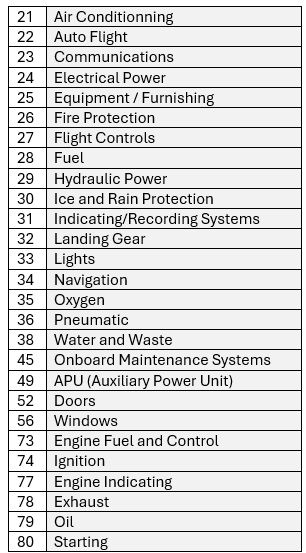
Each chapter is divided into sub-chapters down to a specific system.
Examples :
1. We have a hydraulic failure concerning the Power Transfer Unit (PTU). We will find this failure by following the tree structure below :
29-Hydraulic Power > 29-23 -Transfer Power > 29-23-01- Power Transfer Unit
2.The valve of the wing de-icing system (Wing Anti Ice) is inoperative in the closed position :
30-Ice and Rain Protection > 30-11-Wing Ice Protection > 30-11-01B - Inoperative in the closed position.
Procedure
1-Identification of the failure- It is recorded in the aircraft's logbook (ATL or Aircraft Technical Logbook).
2-Consultation of the MEL- The technician checks if the failure is listed. If not > NO GO (AOG).
3- If yes, Application of any maintenance actions(M) imposed by the MEL.
4-Analysis of operational restrictions (O) by the dispatcher (OCC) for compatibility with flight conditions.
5-Approval by the captain (PIC).
6-Entry of the MEL in the logbook.
> The flight can then be dispatched under MEL in the prescribed conditions and duration.
Remarks :
-The technician must affix a label "INOP" on the control of the deactivated system when required by the MEL.
-Multiple MELs can be opened simultaneously as long as they are not incompatible with each other.
Examples
On an Airbus A320, Pack No. 1 of the air conditioning has been out of service since the last flight. The failure has been recorded in the aircraft's logbook. The technician consults the MEL and refers to the section "Air Conditioning. The failure of a pack is well documented:
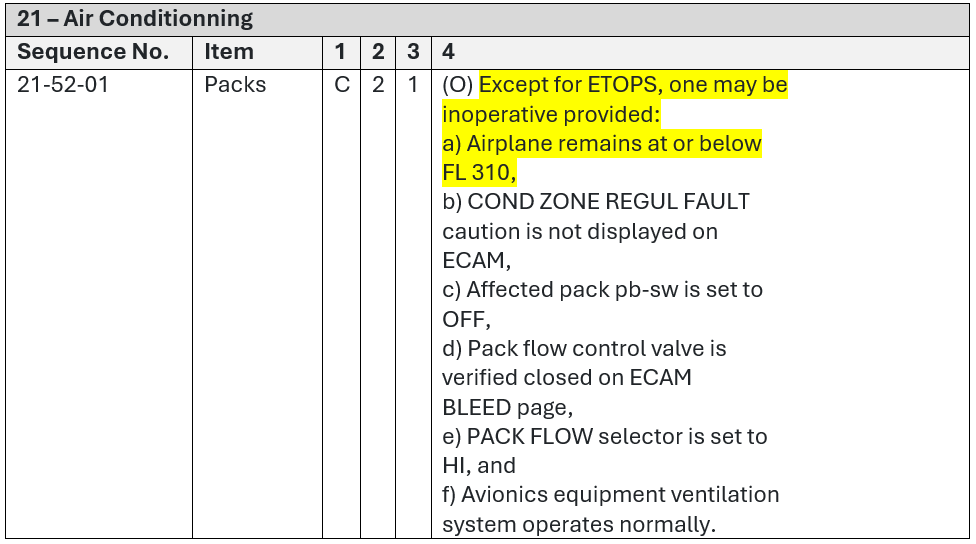
The aircraft can be dispatched under the following conditions :
- Category C: 10 calendar days maximum.
- At least 1 Pack in service out of the 2 installed.
- Operational restrictions (O): Planning at FL310 maximum and no ETOPS route. Other actions are to be applied or verified by the crew in flight.
Additionally, one of the thrust reversers is out of service :
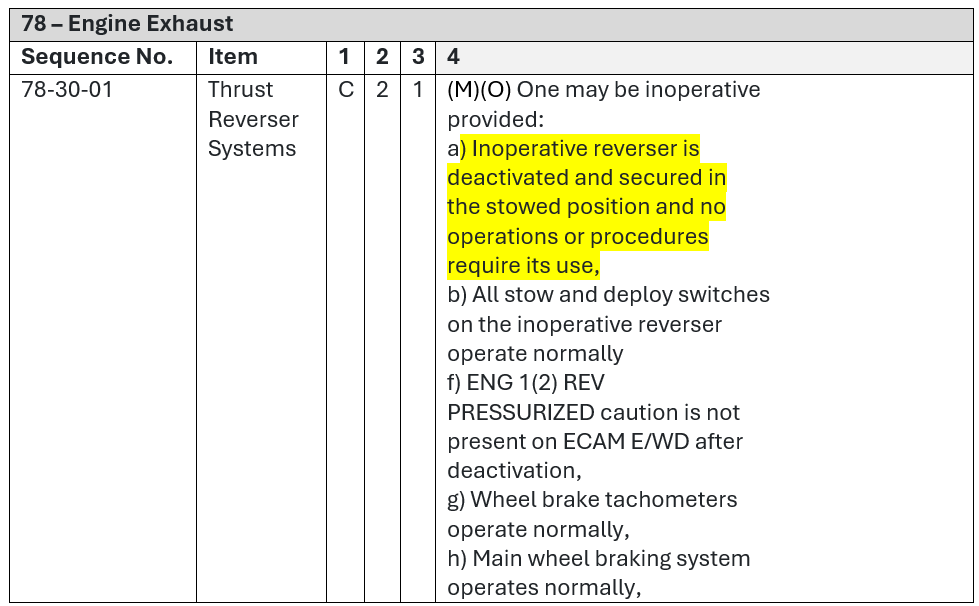
The aircraft can be dispatched under the following conditions :
- Category C: 10 calendar days maximum
- At least 1 Pack in service out of the 2 installed.
- Maintenance actions (M): The inoperative thrust reverser must be disabled and secured in the retracted position.
- Operational restrictions (O): The performance for the planned flight does not require the use of thrust reversers (sufficient take-off and landing distances).
CDL (Configuration Deviation List)
Alongside the MMEL, the manufacturer establishes the CDL, a document containing a list of external items, particularly aerodynamic, of the aircraft that may be missing without compromising structural integrity and flight safety.
Unlike ADDs which concern systems requiring a MEL, the items listed in the CDL do not have a validity limit and may be missing for an indefinite period. However, the company's maintenance manual or manufacturer instructions may sometimes require repairs within certain timeframes.
Like a MEL, a CDL can lead to operational restrictions (performance, consumption, etc.).
Examples of items listed under CDL: Fairings, winglets, hatches...
References
ORO.MLR.105 from EASA regulating the MEL.
CS-MMEL from EASA defining the minimum equipments.
JASC Code Table from the FAA listing the ATA chapters.
LiL